

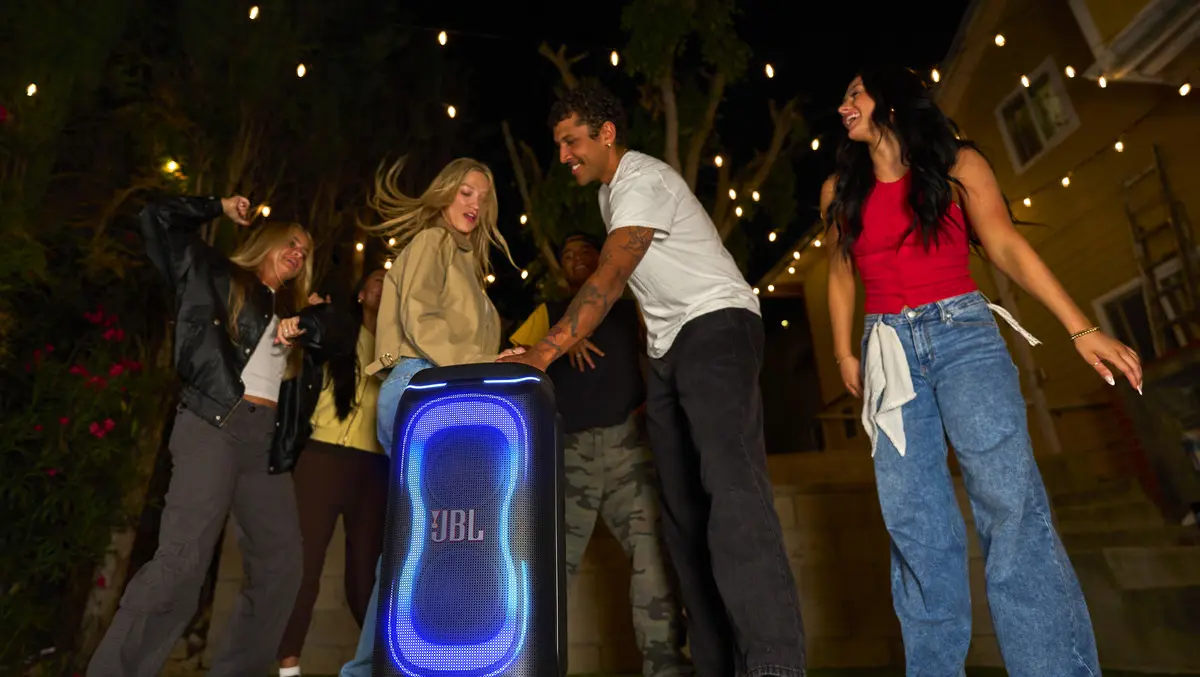
JBL launches PartyBox 330 & 130 speakers in New Zealand
Wed, 2nd Sep 2026
JBL has launched the PartyBox 330 and PartyBox 130 in New Zealand, expanding its PartyBox range in the local market.
The rollout brings updated designs, revised lighting features and changes to the audio hardware in both models. JBL is offering each speaker in black and white, with the larger PartyBox 330 priced at NZD $899.95 and the PartyBox 130 at NZD $599.95.
The launch targets a segment of the consumer audio market where brands are combining portable speakers with social and entertainment use cases. Both models include microphone and guitar inputs, and both can connect to televisions through an optical input, extending their role beyond simple music playback.
Two models
The PartyBox 330 is the larger of the two. It delivers 280W RMS total output power and uses dual 6.5-inch woofers with twin 25mm PEN dome tweeters.
It offers up to 18 hours of playtime and supports fast charging, with 10 minutes of charging providing up to two hours of use on average. The battery is replaceable, though sold separately.
Portability is a central part of the 330's design. It includes a telescopic locking handle and wide wheels, and carries an IPX4 splash-resistance rating.
For users who want a smaller option, the PartyBox 130 delivers 200W RMS total output power through dual 5.25-inch woofers and twin 25mm silk dome tweeters. It offers up to 15 hours of playtime, with a 10-minute fast charge adding 80 minutes on average.
The smaller unit also has an IPX4 splash-proof rating and a redesigned foldable handle for portability. Like the larger model, it includes a central control dial and onboard controls for sound and lighting.
Design changes
Both speakers introduce a new industrial design for the PartyBox line. JBL has adopted a hexagonal profile and curved front grille, while rebuilding the top panel around a single dial for volume, audio modes and lighting effects.
The visual changes are matched by revised lighting systems. On the PartyBox 330, JBL has added ripple-style side-panel elements and beat-synchronised edge lighting effects. The PartyBox 130 uses strobe edge lights and dynamic effects aimed at smaller spaces and more portable use.
That emphasis on lighting reflects a broader trend in portable audio, where manufacturers are trying to make speakers part of the setting rather than just a source of sound. In this category, design and visual presentation can be as important to buyers as battery life or driver size.
Connectivity focus
Each speaker supports Bluetooth 6.0 and Auracast multi-speaker connectivity, allowing users to pair several compatible JBL speakers. JBL also includes USB-C audio input, 3.5mm auxiliary input and support for the JBL One app.
The optical input stands out because it broadens the speakers' use in home entertainment. Rather than limiting them to mobile playback, JBL is also positioning them for karaoke sessions, televised sport and other living-room gatherings.
Both models are compatible with JBL EasySing microphones, reinforcing that push into group entertainment. Dual microphone and guitar inputs on each speaker suggest the devices are aimed not only at casual listeners but also at users who want a more active party or performance setup.
Materials and pricing
JBL has also highlighted the materials used in each model. The PartyBox 330 is made from 70% post-consumer recycled plastic, while the PartyBox 130 uses 82% post-consumer recycled plastic. Both include recycled tweeter magnets and ship in FSC-certified packaging printed with soy-based inks.
Such disclosures have become more common across consumer electronics as brands face growing scrutiny over manufacturing and packaging choices. While the environmental impact of portable audio remains difficult to assess from material percentages alone, recycled plastics have become an increasingly visible part of product positioning in the sector.
The speakers will be available through JBL's own channels and major electronics and general merchandise retailers in New Zealand, including PB Tech, Spark, JB Hi-Fi, Harvey Norman, Noel Leeming, The Warehouse, Heathcotes, Mighty Ape and 100% stores. The broad distribution suggests JBL is targeting mainstream consumer demand rather than a niche premium launch.
JBL described the two products as the next generation of its PartyBox line, a category that has become an important bridge between portable Bluetooth speakers and larger home audio systems. With the PartyBox 330 and PartyBox 130, the company is aiming at both ends of that market: one model designed to move from room to room or venue to venue, and another for buyers who want a lighter, lower-cost option without giving up key entertainment features.