

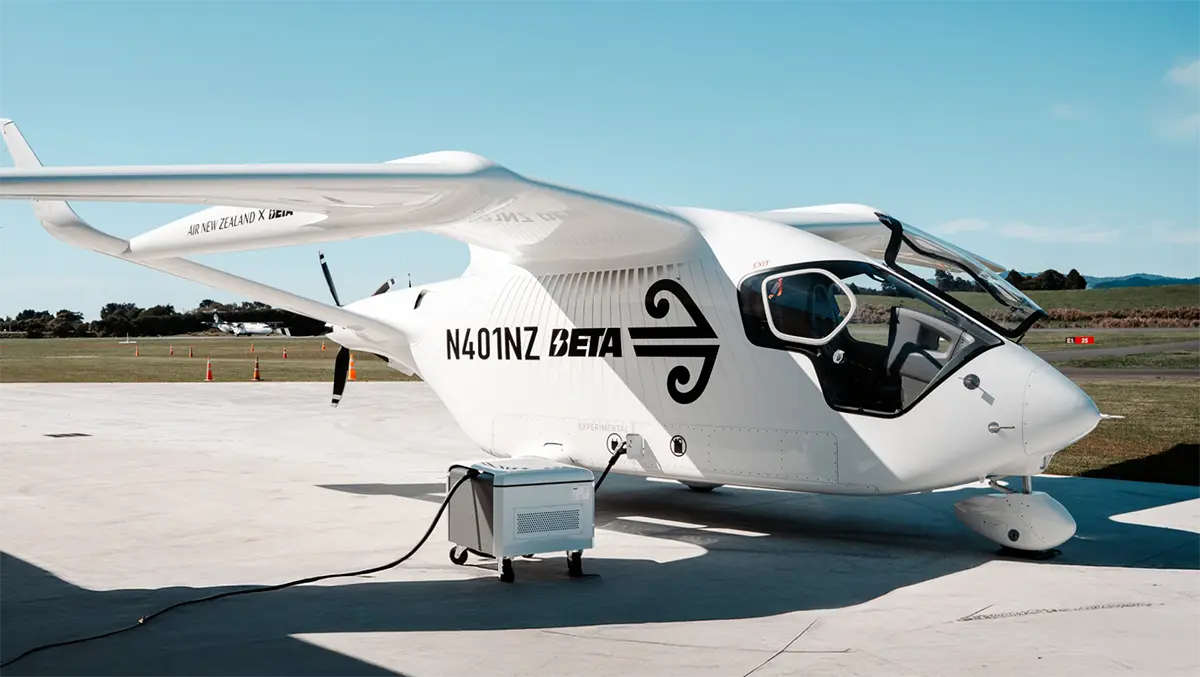
Air New Zealand launches electric aircraft trials on domestic routes
Thu, 6th Nov 2025
Air New Zealand has commenced a technical demonstrator programme for electric aircraft, introducing the BETA ALIA CX300 into service across a series of domestic routes. The trials mark the first time an electric aircraft will operate under the airline's livery, following a period of collaborative preparation with BETA Technologies, the Civil Aviation Authority, and regional airports.
Flight operations
The ALIA CX300, a battery-electric aircraft produced by Vermont-based BETA Technologies, will undertake a range of flights from Hamilton, with planned stops in Taupō, Napier, and Palmerston North before reaching Wellington. The operation will extend to Cook Strait crossings between Wellington and Blenheim, with the demonstration phase scheduled until early 2026.
The aircraft accommodates two crew members and a cargo hold of up to 5.6 cubic metres, with a maximum range of approximately 398 kilometres. Routes in the demonstration will be capped at 200 kilometres to gather operational and environmental data under realistic conditions.
Pilot collaboration
Air New Zealand pilots Andrew Mercer and James Owen will fly alongside BETA Technologies' team. The purpose is to develop operational experience within a variety of New Zealand weather and airport conditions, as well as to refine training protocols that could benefit future deployment both domestically and internationally.
"Sixty percent of regional flights in New Zealand are less than 350 kilometres, and around 85 percent of our electricity is renewable - the perfect laboratory for next generation aircraft. While new propulsion technologies are still developing, BETA is leading the way and we're witnessing a true technology step-change. New Zealand is a country with a pioneering spirit and has always been a fantastic place to try new things. In bringing the ALIA CX300 to New Zealand, we've experienced true collaboration - a world-leading global innovator in BETA Technologies working with Kiwi engineers, pilots, regulators and airports - all focused on understanding how this emerging technology can be safely and practically integrated into the New Zealand airspace when it's scalable and ready," said Nikhil Ravishankar, Chief Executive, Air New Zealand
Regulatory involvement
The Civil Aviation Authority (CAA) is actively involved in the technical demonstrator programme to understand the capabilities and requirements of emerging electric aircraft technologies and their fit within regulatory frameworks. The project enables the CAA to develop regulatory guidance for integrating electric propulsion into New Zealand's aviation system.
"Emerging aviation technologies don't always fit into existing rules, so it's our job to facilitate a clear pathway that helps operators safely bring these technologies into New Zealand's unique aviation system," said Kane Patena, Director and Chief Executive, Civil Aviation Authority
Charging solutions
The electric aircraft's operations are supported by mobile 65kW charging units deployed at Hamilton, Wellington, and Blenheim airports. These chargers, supplied through Air New Zealand's Climate and Nature Fund, allow the aircraft to recharge in under 90 minutes, supporting daily multi-route schedules. The ALIA CX300 features conventional take-off and landing capability, making it compatible with current airport infrastructure.
Industry perspective
For BETA Technologies, the New Zealand programme offers practical insights into aircraft deployment and performance in diverse environments, as well as collaboration with local infrastructure partners.
"Launching this programme is an exciting moment for BETA, as it marks the early stages of operations with Air New Zealand. Our aircraft are designed to carry out all types of flight missions, and this programme represents the next step in validating and preparing our technology for rigorous, real-world environments. This collaboration between airline, regulator, and infrastructure partners sets an example for how the aviation industry can continue to progress and innovate while safely bringing lower-emission, lower-cost, next-generation aircraft into service," said Simon Newitt, Head of Global Sales, BETA Technologies
Local airport participation
Hamilton Airport is hosting the initial phase of flight tests for the ALIA CX300. The airport's leadership highlights the opportunity to support knowledge-building for future aviation infrastructure throughout the country.
"The Hamilton airspace is a great place to learn and understand the systems, infrastructure, and logistics that will one day support next-generation aircraft across the country, and we're excited to be part of that learning for the future," said Mark Morgan, Chief Executive, Hamilton Airport