

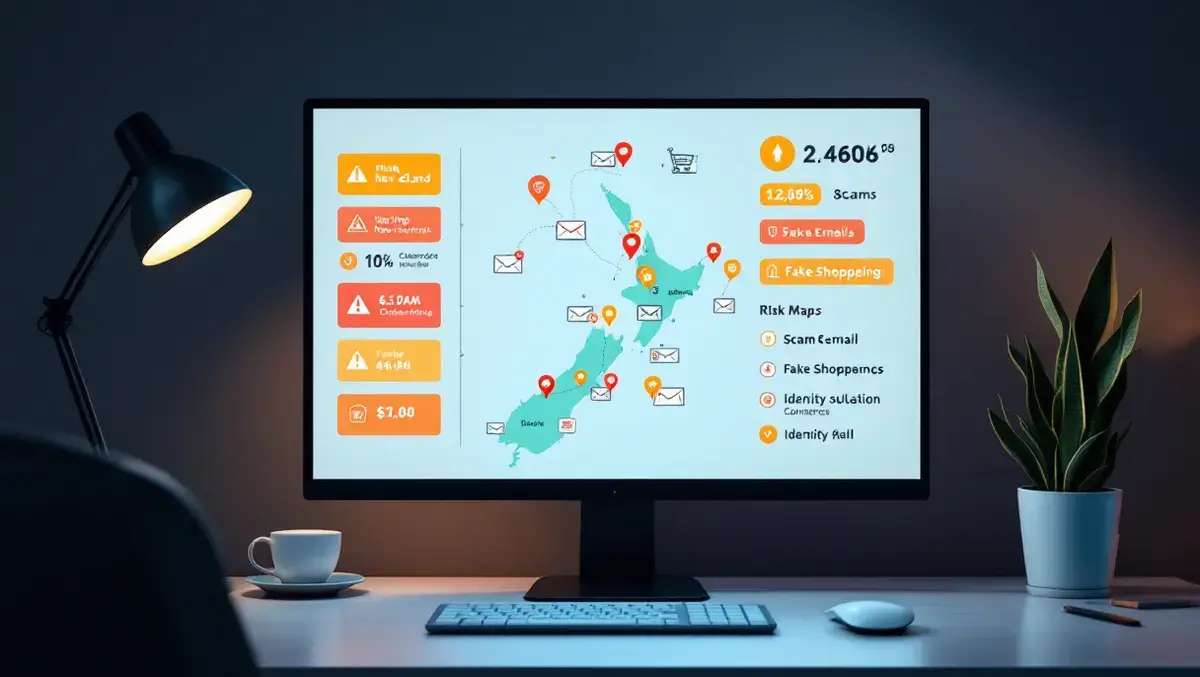
Gen launches cyber risk index for New Zealand users
Tue, 4th Aug 2026 (Today)
Gen has launched the Fearless Planet Index, a cyber safety intelligence hub that provides a live view of scams, cyber threats and identity risks in New Zealand and worldwide.
The index draws on telemetry from Gen Threat Labs and updates daily on emerging online risks. Users can select a country to view prominent scams, malware threats and identity alerts, and see whether each category has risen, fallen, remained stable or appeared for the first time since the previous day.
The service is intended to give consumers a clearer picture of the digital risks affecting them locally, rather than relying only on global trends. It also includes detailed profiles of individual threats and alerts, along with practical information on how to respond.
At launch, the index covered 245 countries and territories. Early platform data showed phishing was the most prevalent scam category globally, with more than 120 million phishing attacks detected in the latest 30-day snapshot.
More than 80% of categorised threats recorded by the index were scams or malicious advertising rather than traditional malware. The figures suggest cyber criminals are increasingly relying on deception and social engineering techniques that target routine online activity such as shopping, payments and account access.
New Zealand picture
In New Zealand, online shopping scams were among the most prevalent consumer scams tracked by the index in July. Fraudsters were increasingly impersonating trusted retailers through fake websites, sponsored social media ads, manipulated search results and promotional emails advertising goods at unusually low prices.
This pattern reflects how far everyday consumer behaviour has become a target for online fraud. Rather than focusing on technically complex attacks, many scams now rely on convincing users to hand over money, personal data or account credentials during ordinary purchases.
Guidance published through the platform advises consumers to use known retailers or check independent reviews before buying from unfamiliar websites. It also recommends checking web addresses for misspellings, reviewing contact and returns information, and using payment methods that offer buyer protection instead of bank transfers, cryptocurrency or gift cards.
Regional trends
The launch data also points to significant variation in threat patterns between markets. While phishing ranked as the leading scam globally, named scam types such as online shopping fraud, dating scams, tech support scams and financial scams varied considerably by country.
That national variation is a central feature of the new service. By showing local threat patterns rather than only broad international totals, the index aims to help users understand the specific risks most likely to affect them where they live.
Among regional averages, North America recorded the highest digital risk score at 29.6%, followed by Europe at 28.5%, Asia-Pacific at 27.4%, the Middle East and Africa at 25.6%, and Latin America at 22.0%.
Consumer focus
Gen is best known for consumer cyber security brands including Norton, Avast and LifeLock. The launch of a public-facing threat monitoring tool extends that approach by turning internal threat data into an information service consumers can access directly.
The platform functions as a kind of weather map for digital risk, translating large volumes of security signals into a more accessible visual overview. That framing reflects a wider effort across the cyber security industry to explain online threats in simpler terms to non-technical users.
For businesses and policymakers, the release also offers another indicator of how scam activity is shifting. The data suggests a threat environment in which malicious advertising and fraud account for a larger share of user risk than conventional malware infections alone.
That matters in markets such as New Zealand, where online retail, social media and search platforms are now common points of exposure. Fraudulent storefronts and misleading paid promotions can be difficult to distinguish from legitimate sellers, particularly during seasonal sales periods when discounting is expected.
Online shopping scams ranked among the most prevalent named scams not only in New Zealand but also in Australia and other parts of the world, underlining the cross-border nature of consumer fraud. The platform's localised view is intended to help people identify where threats are emerging and what forms they are taking.
The index currently presents day-to-day changes in threat levels, allowing users to track whether certain scams are becoming more active over time. It converts billions of real-world security signals into an interactive picture of the current digital threat landscape.