

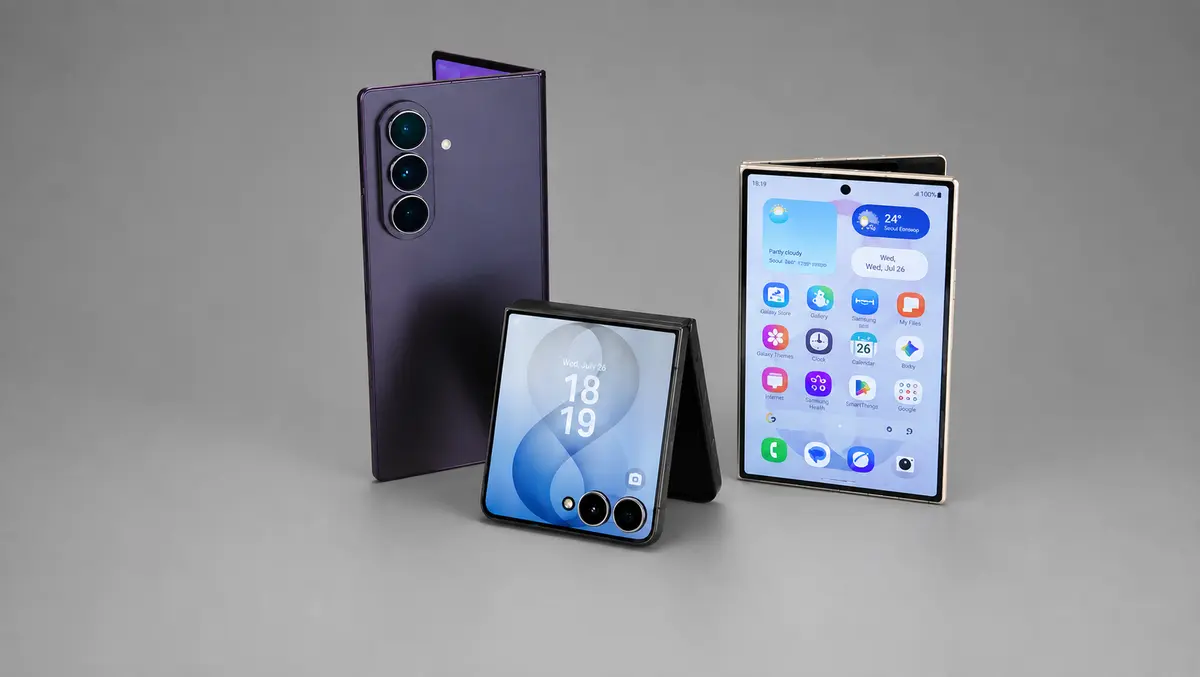

Back in 2019, Samsung became the first mainstream manufacturer to bring foldable technology to market in the form of the Galaxy Fold - writing a new chapter in the history of smartphones.
In the seven-and-a-half years since, consumers have been slow to embrace this futuristic tech for several reasons, including concerns surrounding durability, visible creasing on the display and the premium cost associated with foldable phones.
On the eve of Apple announcing its first foldable smartphone, Samsung may have just created one of the most compelling cases for those hesitant to adopt this technology for their next smartphone upgrade in the innovative Galaxy Z Fold8.
Launching alongside the Galaxy Z Fold8 Ultra and the Z Flip8, the Z Fold8 is available from $3,099 NZD.
First impressions
Samsung's Z Fold8 is unlike any other phone I've used and it's arguably one of the most exciting and daring smartphone designs of the past 10 years.
Unlike other foldable phones, it boasts a much smaller form factor and is roughly the size and shape of a standard passport. Because of this, the front AMOLED screen is notably smaller at 5.5 inches, but that comes with an upside - it's really easy to use with one hand. The bezels around the screen are wider than many might like, but that's a small trade-off considering the functionality of the phone.
Weighing in at just over 200g, the Z Fold8 is light as far as foldable phones go. It's not too chunky, either, at just 9.7mm when closed or 4.5mm when open. Despite its light and slender build, the Z Fold8 feels reassuringly premium, with Samsung's Advanced Armour Aluminum frame and Gorilla Glass helping it feel considerably more robust than you might expect from such a slim device.
When you do open the device, the tablet-style AMOLED display measures 7.6" and looks mightily impressive with a barely visible crease. Creases are one of the main gripes people mention when considering a foldable phone, but Samsung has done a great job of keeping it discreet. It's only really noticeable when light hits it at a certain angle. The screen also offers a 4:3 aspect ratio, making it excellent for multitasking between apps, web browsing, and reading.
The right-hand side of the phone houses the power button, which doubles as a fingerprint reader, and the volume slider. The back of the device holds two camera lenses - a 50MP wide and 50MP ultrawide. There is a lack of a telephoto lens on this model - that's available exclusively on the Z Fold8 Ultra.
Speaking of cameras, there are two punch hole front-facing lenses on the phone - one for each screen, which aren't too noticeable. The lens built into the larger display effectively becomes invisible if you're watching widescreen content, which is a big plus.
Opening and closing the Z Fold8 feels satisfying and robust, and Samsung rates the hinge for up to 200,000 folds (which equates to around 100 per day for five-and-a-half years). Samsung calls this the 'Armour FlexHinge' which is thinner and more rigid than the mechanism found in older foldables.
Performance and features
After several weeks with the Galaxy Z Fold8, I became a convert to foldable smartphones. Admittedly, and perhaps to my shame, I am very much embedded into Apple's ecosystem, but this is the first Android I've used in years that's made me question that decision.
I found the smaller screen great for doing quick things like checking my emails or replying to WhatsApp messages, but I consume a lot of video content through my smartphone, so I made full use of the larger screen - meaning my iPad sat there collecting dust for three weeks.
Watching YouTube, Netflix and Disney+ on the phone was a great experience. Because of the screen's 4:3 aspect ratio, widescreen content doesn't fill the entire display, leaving fairly substantial black bars above and below the picture. The upside, as mentioned earlier, is that this effectively hides the cutout camera.
It's worth noting that the unusual aspect ratios of both screens mean some apps aren't fully optimised for the phone yet. This isn't a deal-breaker, but you'll occasionally encounter apps that don't make perfect use of the available screen real estate.
The cameras are good but not outstanding. The main 50MP sensor worked well in daylight, while I managed to get some great landscape shots with the ultrawide. Zooming into shots is only done digitally, and this works fine until you want to go past 4x magnification, where the finer details of your image start to deteriorate. One neat trick, which is certainly a plus of foldables, is you can use the front screen as a 'mirror' while utilising the rear cameras for a selfie. Smart AI stabilisation helps keep video content steady when you're on the move.
Talking of AI, Samsung's Galaxy AI features are well integrated into the Z Fold8. The ability to do things like summarise web pages and documents, rewrite text and quickly translate content proved genuinely useful, particularly when used on the larger display. AI-powered photo editing is another highlight, making it easy to remove unwanted objects or make quick adjustments without having to go into a separate app. While not every AI feature feels essential, the ones I regularly used felt like natural extensions of the phone rather than gimmicks, and the Fold8's larger screen makes many of them even more practical.
Multitasking is really where the Z Fold8 shines. Everything feels super fluid through Samsung's UI, with the new Snapdragon 8 Elite Gen 5 processor providing more than enough power to keep everything running smoothly.
The battery life of the Z Fold8 was another highlight for me. The phone holds a 4800 mAh battery, which is good enough for up to 26 hours of video playback. A full charge takes around one hour using 45W USB-C charging.
My time spent with the Z Fold8 really surprised me, and I liked it considerably more than I thought I would. Yes, it's expensive, and the long-term durability of a folding display and hinge remains a question mark compared with a conventional smartphone - particularly when exposed to dust, debris or accidental damage.
Verdict
I am due to upgrade my iPhone 14 Pro and having spent some time with the Samsung Galaxy Z Fold8, I'm now genuinely considering taking a leap of faith into the world of Android.
That's perhaps the biggest compliment I can give the Galaxy Z Fold8. I've spent years being perfectly happy with my iPhone, and I went into this review expecting to enjoy the novelty of a foldable before returning to the familiar comforts of iOS. Instead, Samsung has built a phone that genuinely made me question whether I want to stay there.
At $3,099, the Z Fold8 remains an expensive option, and it's not without its compromises. However, for anyone willing to embrace a different way of using a smartphone, Samsung has created one of the most exciting and genuinely useful phones I've used in years. Let's see how Apple responds…