


Apple has announced updated MacBook Air and MacBook Pro lines based on its new M5 chip family, alongside a refreshed Studio Display and a new Studio Display XDR.
The launch extends Apple's push for more on-device processing for AI-related workloads across mainstream and professional Macs. It also refreshes the company's desktop story, with new displays aimed at users who want a single-cable connection and expanded peripheral support.
MacBook Air update
The new MacBook Air uses the M5 chip and comes in 13-inch and 15-inch versions. Apple said it targets a wide range of users, including students, creative professionals, and business customers.
The M5 in MacBook Air includes a 10-core CPU and up to a 10-core GPU. Apple said the GPU includes a Neural Accelerator in each core, improving AI processing speed compared with earlier models.
Storage is a headline change. MacBook Air now starts with 512GB-double the previous base configuration, Apple said-and can be configured with up to 4TB.
This generation also introduces Apple's N1 wireless chip to MacBook Air, with support for Wi‑Fi 7 and Bluetooth 6.
Beyond the processor and wireless updates, the MacBook Air keeps familiar features: a Liquid Retina display, a 12MP Centre Stage camera, up to 18 hours of battery life, Spatial Audio, and two Thunderbolt 4 ports. Apple also said it supports up to two external displays.
Colour options include sky blue, midnight, starlight, and silver.
Apple framed the update as a broad performance refresh.
"The new MacBook Air with M5 brings incredible performance and even more capability to the world's most popular laptop," said John Ternus, Senior Vice President of Hardware Engineering, Apple.
MacBook Pro refresh
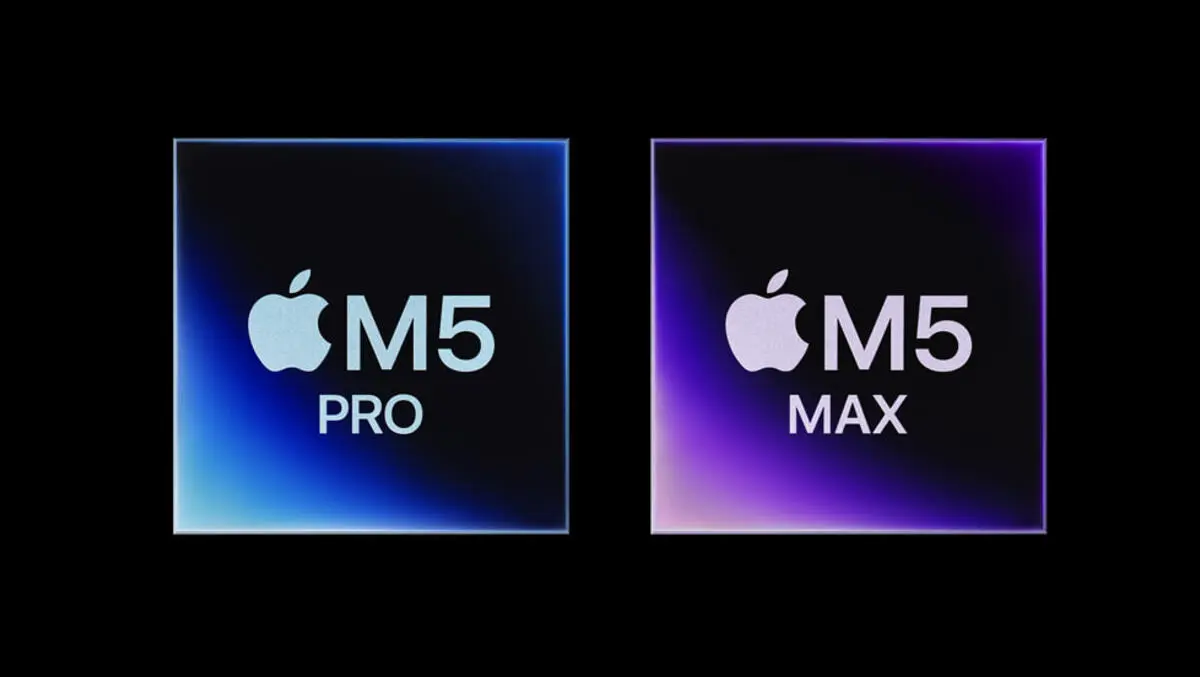
Apple has updated the 14-inch and 16-inch MacBook Pro with new M5 Pro and M5 Max chips. It said the new systems increase CPU and GPU performance and raise baseline storage configurations across the Pro line.
M5 Pro and M5 Max include an up-to-18-core CPU. Apple said the design uses six "super cores" and 12 performance cores, and a next-generation GPU architecture with a Neural Accelerator in each GPU core.
Apple linked the chip update to on-device AI use cases, saying the new MacBook Pro delivers up to four times AI performance compared with the previous generation and up to eight times compared with M1 models. Apple said this supports tasks such as LLM prompt processing and AI image generation.
Storage and connectivity also change. Apple said MacBook Pro now offers up to two times faster SSD performance and starts at 1TB of storage for M5 Pro configurations and 2TB for M5 Max configurations. The new models also include the N1 wireless chip for Wi‑Fi 7 and Bluetooth 6, plus Thunderbolt 5 ports, HDMI, an SDXC card slot, and MagSafe 3.
Apple quoted battery life of up to 24 hours. It also highlighted the Liquid Retina XDR display, with an optional nano-texture finish.
Ternus said Apple sees the update as setting a new bar for professional laptops.
"MacBook Pro with M5 Pro and M5 Max redefines what's possible on a pro laptop, now up to 4x faster than the previous generation," said Ternus.
Fusion architecture
Apple also shared more detail on the M5 Pro and M5 Max design, saying both use a new "Fusion Architecture" that combines two dies into a single system on a chip. Apple said this integrates the CPU, GPU, Media Engine, unified memory controller, Neural Engine, and Thunderbolt 5 support.
For memory, Apple said M5 Pro supports up to 64GB of unified memory with up to 307GB/s of bandwidth, while M5 Max supports up to 128GB with up to 614GB/s.
Johny Srouji, Senior Vice President of Hardware Technologies, linked the architecture to Apple's broader silicon roadmap.
"M5 Pro and M5 Max are a monumental leap forward for Apple silicon, leveraging our new Fusion Architecture to scale the capabilities of Apple silicon while preserving its core tenets of performance, power efficiency, and unified memory architecture," said Srouji.
Display line-up
Apple also announced a new Studio Display and a new Studio Display XDR, which it said replaces Pro Display XDR.
The updated Studio Display keeps a 27-inch 5K Retina panel and adds Thunderbolt 5 connectivity. Apple said it also includes a 12MP Centre Stage camera with Desk View, a three-microphone array, and a six-speaker sound system with Spatial Audio.
Studio Display XDR uses a 27-inch 5K Retina XDR panel with a mini‑LED backlight. Apple said it has 2,304 local dimming zones and 2,000 nits of peak HDR brightness, along with a 120Hz refresh rate and Adaptive Sync.
Both displays include Thunderbolt 5 and additional USB‑C ports. Apple said Studio Display can charge a connected Mac at up to 96W, while Studio Display XDR can provide up to 140W. Apple also said the standard Studio Display can be daisy-chained up to four units when used with a MacBook Pro with M5 Max.
Apple said both are available with standard or nano‑texture glass.
Ternus positioned Studio Display XDR as a major step in Apple's monitor portfolio.
"Studio Display gets even better with a new 12MP Centre Stage camera and powerful Thunderbolt 5 connectivity. And the Studio Display XDR is a huge leap forward for XDR technology, with a mini-LED backlight, 2000 nits of peak HDR brightness, advanced colour accuracy, and a 120Hz refresh rate, transforming workflows like filmmaking, design and print, and 3D animation. It's by far the world's best pro display," said Ternus.
The new Macs and displays arrive alongside macOS Tahoe and Apple Intelligence features referenced across the announcements, including Live Translation and updates to Shortcuts and system experiences.