

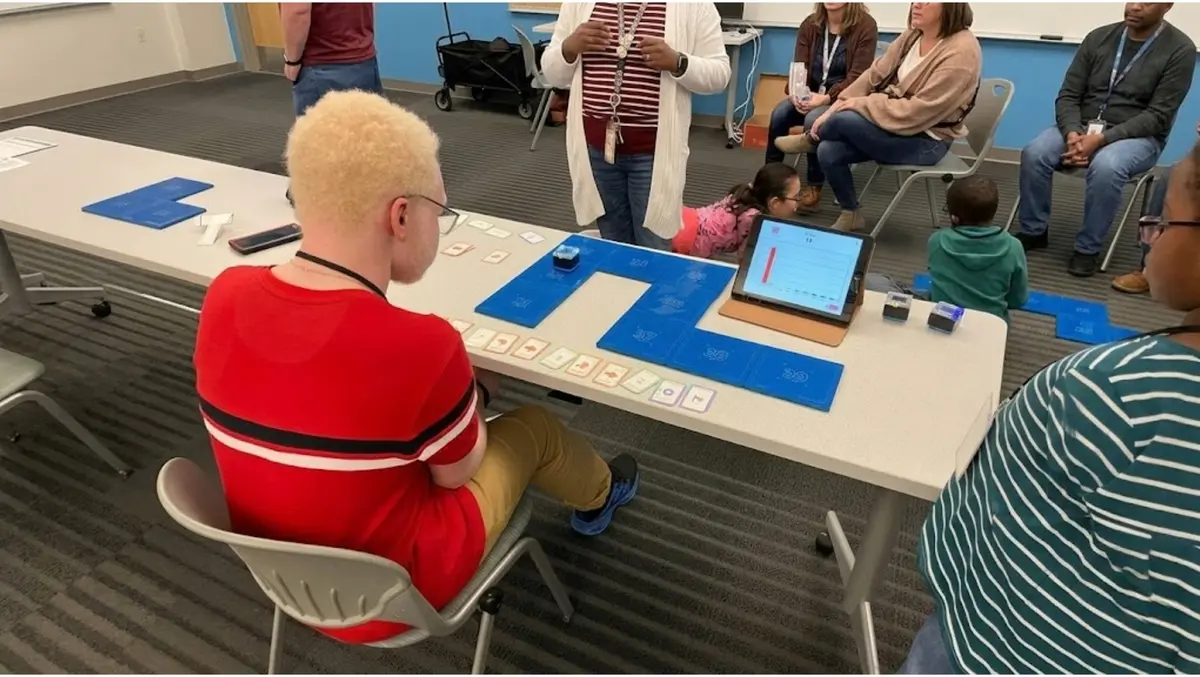

Kai's Education has made its KaiBot coding robot available through the American Printing House for the Blind, widening US distribution for a product aimed at blind and low-vision students.
KaiBot is a tactile coding tool designed to teach coding, sequencing, logic, debugging and problem-solving without relying on a screen. Students use physical coding cards, including Braille-supported cards, to build a sequence, then scan it into the robot, which responds with audio feedback and movement.
The arrangement gives Kai's Education access to a specialist US channel focused on learning materials for blind and low-vision users. It also places the New Zealand company in a market where more than 600,000 children have uncorrectable visual acuity loss, including more than 45,500 who are blind, according to figures cited from Prevent Blindness.
Many coding products still depend heavily on visual interfaces, limiting access for students with sight loss. Kai's Education says its approach starts with touch and is intended to let blind, low-vision, neurodiverse and sighted pupils take part in the same classroom activities.
Accessible design
The product was built around Universal Design for Learning principles. Features include Braille coding cards, a Reader Mode for guided activities, an inbuilt screen reader for audio guidance, level setup assistance for teachers and pupils, and support for multiple languages.
Michael Wood, director of product development at APH, described the launch as part of a wider push to improve access to STEM learning.
"Accessibility in STEM education is important, and KaiBot represents the future of accessible STEM learning. We are proud to launch KaiBot with braille support, helping ensure that students who are blind or low vision can fully engage in coding, creativity, and hands-on learning alongside their peers," Wood said.
Kai's Education positions KaiBot as an early step into computational thinking before students move on to digital coding environments such as Blockly and Python. Its emphasis on physical interaction is intended to give learners a concrete way to understand instructions, sequencing and debugging.
Classroom use
During field testing focused on accessibility, educators reported strong engagement from blind, low-vision and neurodiverse learners, according to Kai's Education. Teachers also highlighted greater independence, collaboration and confidence as pupils worked through coding tasks using tactile and audio support.
Bruce Jackson, founder and CTO of Kai's Education, said the product was designed to address a longstanding gap in classroom tools.
"KaiBot was designed to make coding feel accessible, physical, and collaborative. For too long, blind and low-vision students have been expected to adapt to tools that were never designed with them in mind. KaiBot gives students a way to participate in the same coding challenges as their peers, using touch, sound, movement, and problem-solving," Jackson said.
The company focuses on K-10 education and develops products for hands-on and hybrid STEM learning. Alongside KaiBot, its portfolio includes KaiLab, a platform that combines virtual and real-world learning in areas such as coding, robotics, automation and AI.
The US launch through APH marks a notable step for Kai's Education as it seeks broader adoption beyond its home market. Specialist distributors can play an important role in education technology for disabled learners because purchasing decisions often sit with schools, districts and support organisations that require established accessibility standards and trusted supply channels.
For schools, the product sits within a broader debate over inclusion in STEM teaching. While digital literacy is increasingly treated as a core skill, access to introductory coding tools remains uneven for pupils who cannot use screen-based systems easily or independently.
Jackson said the company sees accessibility as a starting point rather than an add-on.
"Coding should not begin with a barrier. It should begin with access. Our goal is to help every student take part in the same learning experience, whether they are coding through touch, sound, movement, or screen-based tools," he said.