

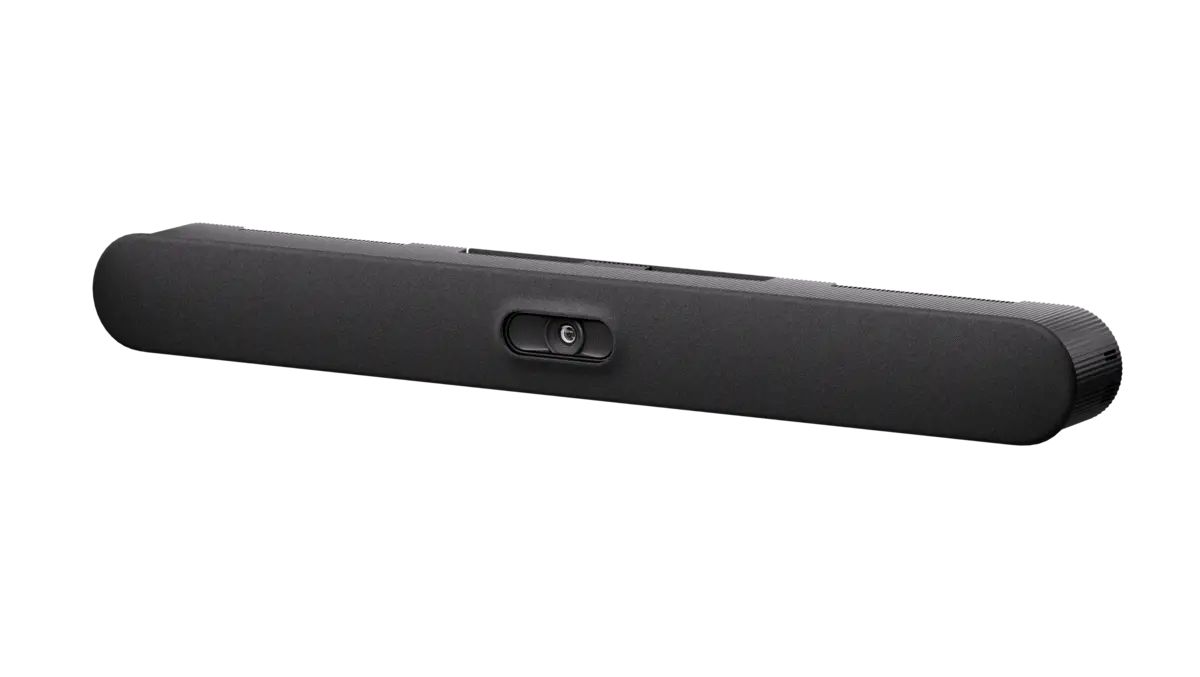

Logitech is making its biggest step yet into the B2B market, launching a new generation of workplace video conferencing hardware, led by the Rally Bar 2, as the Swiss-based company looks to give enterprise meeting rooms more processing power and greater support for AI-enabled features.
The Rally Bar 2 is designed to replace both the existing Rally Bar and Rally Bar Mini, combining the wider field of view and flexibility of the smaller device with the processing power and room coverage of the larger model.
Craig Ishii, Head of Product Marketing for Team Workspace Solutions at Logitech, said additional processing capacity has been deliberately built into the new device to allow it to support future software and AI features.
"When we think about all the different features that now use AI, there's a lot more need for processing power," he said.
The Rally Bar 2 will feature Qualcomm's latest processor, which provides significantly more processing power than competing second-generation video bars.
Ishii said the company had taken a similar approach with the original Rally Bar, deliberately including more computing capability than the product required when it launched.
Logitech has subsequently used that additional capacity to introduce features including automatic room booking and release, grid view, depth blur and multi-stream support for Microsoft Teams Rooms.
More than 18 major software upgrades have been delivered to first-generation devices since launch, keeping meeting-room hardware relevant with fresh features through the product's lifecycle.
The company also recently upgraded its devices to Android 12, which extends the certification timeline for platforms including Microsoft Teams, Zoom and Google, while some competing first-generation video bars are only certified through 2027 because they did not receive comparable Android upgrades.
The Rally Bar 2 is intended to provide a longer-term platform for organisations deploying meeting-room technology, with its additional processing capacity designed to accommodate future software developments.
New camera & audio capabilities
The Rally Bar 2 will feature the same custom camera technology Logitech introduced with its Rally Board 65.
The camera uses a one-inch sensor designed to improve colour, light capture and image detail, while providing a 115-degree field of view, with a built-in privacy shutter.
On the audio side, the device will use Logitech's RightSound 3 technology, which is designed to improve vocal clarity in rooms with hard surfaces and reverberation.
The Rally Bar 2 features four speakers, including two tweeters intended to improve higher-frequency audio.
While adding additional capabilities, Logitech has also made the new bar thinner than its predecessor. The device will sit less than 100 millimetres from the wall when mounted.
The system will support Google Meet, Zoom and Microsoft Teams, including Teams Rooms on Windows and Android, Zoom's PC-based and appliance deployments, and bring-your-own-device configurations.
The Rally Bar 2 will also be Logitech's first device supporting Microsoft's Device Ecosystem Platform, or MDEP, which the company described as providing a foundation for future security requirements.
Google Meet support will be provided through Android and BYOD, with Logitech noting that Google is moving away from Chrome OS deployments.
Ending 'ghost meetings'
One of the more prominent software features arriving alongside the latest generation of hardware is automatic room booking and release.
The system uses the camera as an occupancy sensor, allowing the bar to detect whether a person is present without identifying them.
But Ishii stressed that Logitech does not use the system to collect personal information.
When a person enters an equipped meeting room, the system can create a calendar booking through Logitech Sync. If that person leaves early, the booking can automatically be released.
The same process applies when a staffer books a room but does not attend.
Administrators can also configure the system to remove recurring bookings when the booked room repeatedly goes unused, addressing the issue of 'ghost bookings' that leave meeting rooms unavailable for weeks or even months on end, despite being empty.
The functionality does not require an additional occupancy device, as the video bar itself is already installed to provide video conferencing.
Simplifying enterprise meeting room installations
Logitech is also introducing a new Logitech Link connectivity system intended to reduce the complexity of installing larger meeting-room deployments.
The system uses category cable connections to carry power and data between compatible Logitech devices.
Ishii said this will allow additional microphones and cameras to be connected without requiring additional couplers or dongles.
The Rally Bar 2 will support Rally Mic Pod 2, while future CollabOS updates are expected to enable Logitech's Rally AI Camera and Rally AI Camera Pro to use the same connectivity system.
Logitech is also introducing an auto-provisioning process for the Rally Bar 2.
Administrators can enter a device's serial number and MAC address and apply a configuration profile before installation. Once the hardware is connected, the system can automatically configure itself and connect to the selected meeting platform.
Remote administrators can then use the remote user interface to complete additional configuration.
Targeting complex rooms
Alongside the Rally Bar 2, the Rally System 2 Pro is also being introduced for larger and more complicated meeting spaces.
The modular system combines the Rally AI Camera Pro, Rally Mic Pod 2, a new Rally Speaker 2 and a RoomMate 2 Pro computing unit.
The system can support multiple microphones, speakers and cameras, as well as up to three 4K displays.
Divisible rooms are being specifically targeted, where a large meeting space can be separated into multiple rooms depending on the requirements of a particular meeting.
Two Rally System 2 Pro installations can be connected using Logitech Link and configured through Logitech Sync.
Administrators can then switch between a combined-room configuration and separate room configurations through the meeting controller or Sync's management platform.
The initial configuration will support up to three divisible spaces, according to Ishii.
Logitech is also planning to introduce technology that can automatically switch between camera views depending on where participants are facing.
The system builds on the company's existing Smart Switching technology, which can combine a front-of-room camera with a centre-of-table camera to maintain a more front-facing view of participants to help remote attendees feel better connected.
Speakers utilise Sound Shape technology
Another major part of the new portfolio is the attention given to meeting room audio.
Traditional ceiling speakers can create installation challenges and can result in audio being emitted from behind participants, even when the person speaking appears on screen at the front of the room.
The Rally Speaker 2, however, will use a seven-driver linear array and beamforming technology to provide more consistent audio across a room while keeping the sound source at the front.
For larger spaces, Logitech is introducing the Rally Speaker 2 Pro with a 32-driver matrix array, followed by the Rally Speaker 2 Max with a 64-driver matrix array.
Both larger models use a technology Logitech calls Sound Shape, designed to direct audio into specific zones within a room while reducing the amount of intelligible audio reaching other areas.
This technology could be used in environments such as training rooms or divisible spaces where different groups need to hear different audio, Ishii said.
Sound Shape was described as one of the most significant technology developments in Logitech's new portfolio.